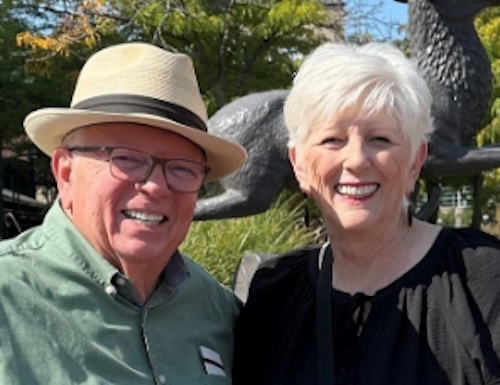
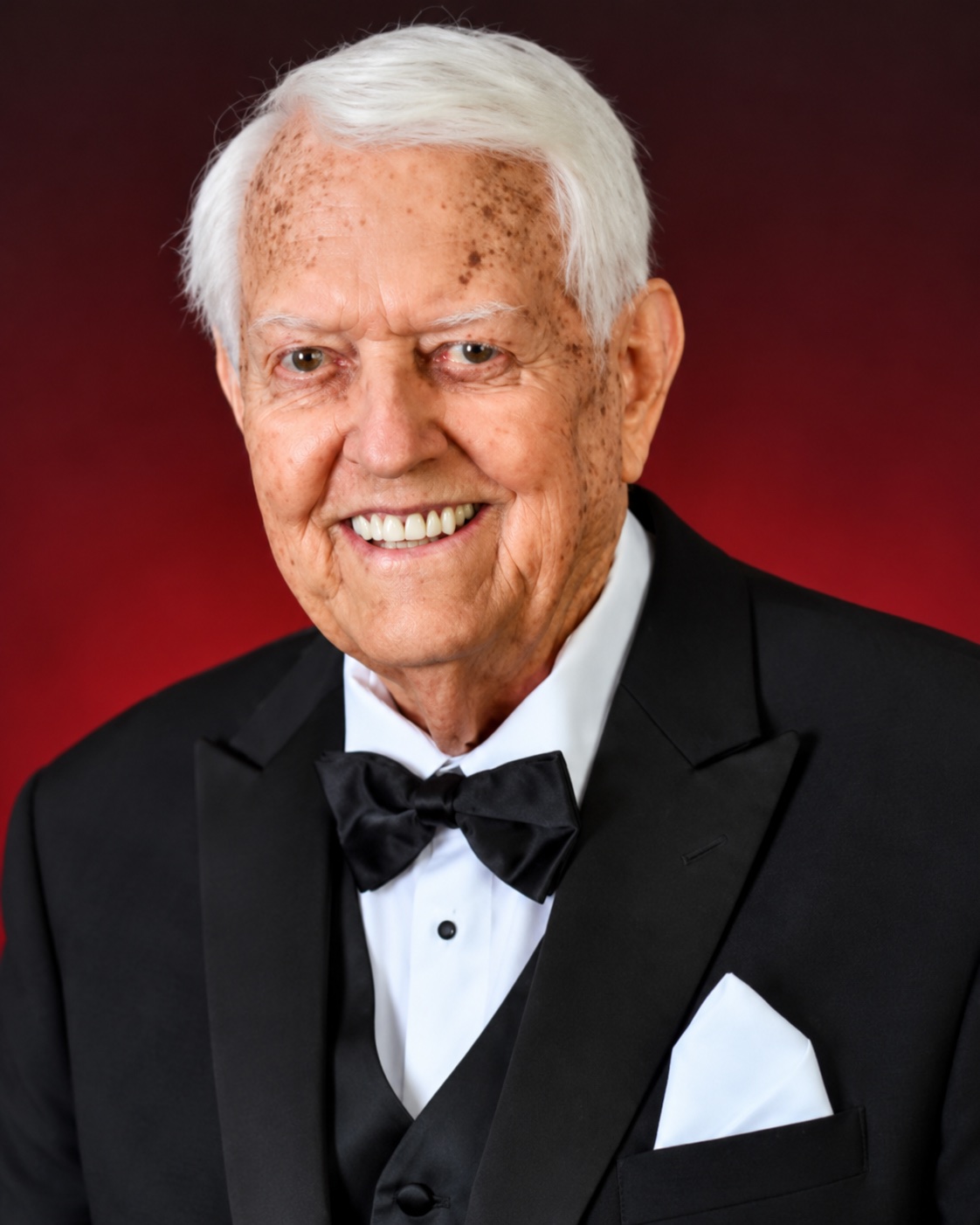
“Perk was country, and I was a country boy,” Davis recalled. “It felt like home. Everybody was friendly, from staff and administration to fellow students. The people became my family.”
Davis immersed himself in campus life. He lettered in basketball and baseball, earned All-State basketball honors, served as vice president of the student government, joined Phi Theta Kappa and, in 1951, received the Dr. D.H. Hollis Trophy, recognizing the sophomore athlete who best exemplified character, leadership, sportsmanship and service.
Yet when Davis reflects on Perkinston, he remembers people more than honors. He recalls coaches George Westerfield and B.T. Nash, professors who influenced him, and evenings when students gathered in Harrison Hall while Natalie “Sunshine” Watson played the piano.
“They were good years,” he said. “They are years I look back on fondly and often and something I wouldn’t trade for anything else.”
Those years would prove foundational.
Not long after leaving Perkinston, Davis was drafted into the U.S. Army during the Korean War. Assigned to Special Services, he organized athletic programs for troops struggling with homesickness and loneliness.
“Arranging all that taught me a lot about coaching and that sports are more than just being physical,” Davis said. “They speak to all areas of your life.”
After his military service, Davis continued his education, eventually earning a doctorate from the University of Alabama. In 1962, he was asked to establish the first men’s basketball program at the newly coeducational University of Montevallo.
Over the next four decades, Davis helped shape Montevallo athletics as a coach and athletic director and later served as president of the National Association of Intercollegiate Athletics.
But for those who played for him, Davis’s legacy reaches beyond wins and titles.
Former Montevallo player Mark Riggins remembers a coach who challenged his players to become better men.
“He was just this monumental figure in our lives, driving us to expand ourselves physically, mentally, and morally,” Riggins said. “He wanted us each to be the best people we could be, and he exemplified that in the person he was.”
Riggins experienced that concern personally when, nearing graduation without a job, Davis selected him for an Alabama all-star basketball team traveling to Rhodesia and Mozambique.
“It is like Coach Davis saw what I needed even when I didn’t,” Riggins said.
That ability to invest in people may be Davis’s greatest accomplishment.
Asked what advice he would offer today’s MGCCC students and student-athletes, Davis returned to the philosophy that has guided his life.
“Enjoy it. Have a great time with it,” he said. “Think about what you’re doing seriously. You represent the school, the state, and your parents. But the most important thing is what’s happening to you as an individual.”
Davis’s career includes championships, awards and national leadership positions, as well as induction into the MGCCC Athletic Hall of Fame in 2002 for both baseball and basketball. But his story began at Perkinston, where a country boy from Alabama found mentors, friendships and a sense of belonging.
He carried those lessons into a lifetime of helping young people find their own way forward.
In the end, that may be the true measure of a coach.